
globalindian.com/lalit-verma

Cover Story · 5 May 2026

Lalit Verma: The cultural curator whose work reached UNESCO, the Kumbh, and Cannes

Lalit Verma is many things — photographer, founder of Aurodhan Art Gallery, curator of over three thousand cultural events, and India's quiet cultural ambassador to the world.

His photographs have graced the Indian Parliament House in New Delhi and UNESCO Paris, earning appreciation from the President and Prime Minister of India as well as the Director-General of UNESCO. His work has travelled from the banks of the Maha Kumbh to the festival screens at Cannes, earning him honours including a Lifetime Achievement Award and the Viswa Ratna. Yet beneath all of it runs a single, animating belief that life unfolds along two parallel paths — the earthly and the divine — and that art, at its best, is where the two meet.

A global voice for oneness

Lalit's latest initiative — Oneness Through Yoga — is a natural extension of his long-running Oneness Through Art movement, exploring how creativity and inner awareness can transcend divisions. Over the decades, through more than three thousand events offered freely to the public, his work has steadily fostered harmony and goodwill, raising what he describes as art consciousness — a collective awakening to beauty, culture, and shared humanity.

Roots in the forest

Born on 15 January 1965 in Ludhiana, Lalit spent his early childhood in the forests of Gomia, near Hazaribagh, where his father worked with Imperial Chemical Industries. "It was an environment both raw and formative — surrounded by nature, unpredictability, and a sense of quiet wonder."

From Tata to Aurodhan

His professional life took shape in the boardrooms of the Tata Group, where he worked under leaders such as Russi Mody during the era of J. R. D. Tata. It was an experience that instilled in him a sense of excellence, discipline, and large-scale thinking — qualities he would carry into his next chapter. That chapter was Aurodhan.

… continues for the full feature

    • Whatsapp Share
    • LinkedIn Share
    • Facebook Share
    • Twitter Share

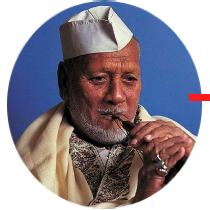
    Ustad Bismillah Khan

    Ustad Bismillah Khan

    Ustad Bismillah Khan, born as Qamaruddin Khan, was an Indian musician who was one of the most famous shehnai players in the world. He was born on March 21, 1916, in Dumraon, a small town in the present-day state of Bihar. Bismillah Khan’s father, Paigambar Khan, was also a shehnai player and taught him the art of playing the instrument.

    CEO’s | Actors | Politicians | Sports Stars

    Early Life of Bismillah Khan

    Born as Qumaruddin Khan on 21 March 1916, the man who would later be known to the world as Bismillah Khan, was born into a family deeply rooted in the tradition of music. His birthplace was the small town of Dumraon, in the then British India. His parents, Paigambar Bux Khan and Mitthanbai, were musicians in the court of Maharaja Keshav Prasad Singh of Dumraon Estate in Bihar, and his grandfathers, Ustad Salar Hussain Khan and Rasool Bux Khan, were also celebrated musicians. As a newborn, his grandfather Rasool Baksh Khan, a shehnai player, joyously exclaimed “Bismillah”, meaning “In the name of Allah”, and thus, the name Bismillah Khan stuck.

    Personal Life

    In his tender age of six, Khan moved to Varanasi, Uttar Pradesh, where he apprenticed under his maternal uncle, Ali Bux ‘Vilayatu’ Khan, a shehnai player attached to the Kashi Vishwanath Temple. By age fourteen, he accompanied his uncle to the prestigious Allahabad music conference. Bismillah was a devout Muslim, yet he found unity in music, performing for both Hindu and Muslim ceremonies, symbolizing a unique religious harmony.

    Professional Life of Bismillah Khan

    Bismillah Khan’s professional journey began with performing at various stage shows. His first major breakthrough arrived in 1937 when he enthralled audiences at a concert at the All India Music Conference in Calcutta. This performance spotlighted the shehnai on the concert stage and was widely appreciated by music aficionados. Over his illustrious career, Khan played in many countries and in many prestigious events worldwide, including the World Exposition in Montreal, Cannes Art Festival, and Osaka Trade Fair.

    Awards and Recognitions

    In recognition of his enormous contribution to Indian classical music, Khan was conferred the Bharat Ratna in 2001, the highest civilian honour in India. With this, he became the third classical musician of India, after M. S. Subbalakshmi and Ravi Shankar, to receive this prestigious award.

    Age

    Bismillah Khan lived a long and fruitful life of 90 years, passing away on 21 August 2006.

    Parents’ Name and Family

    Bismillah Khan was the second son of Paigambar Bux Khan and Mitthanbai. He was part of a family with a rich musical legacy, as his father was a court musician and both his grandfathers were renowned musicians.

    Net Worth

    While Bismillah Khan’s net worth remains undisclosed, his value extends far beyond monetary measures. His priceless contributions to Indian classical music, specifically the popularization of the shehnai, remain his enduring legacy.

    Divya Deshmukh wins FIDE Women’s World Cup—becomes India’s 88th Grandmaster, only the 4th woman ever. Deepika Padukone named among 90 Global Women Shaping Culture’ by The Shift. Shobana Radhakrishnan, an Indian-origin senior engineer at Google, is set to receive the 2025 Hedy Lamarr Innovation Award. PM Modi lands in London—a billion-dollar deal is on the table. From Patna to the world stage—Vidhu Ishiqa just claimed the Mrs Earth International 2025 crown.
    Divya Deshmukh wins FIDE Women’s World Cup—becomes India’s 88th Grandmaster, only the 4th woman ever. Deepika Padukone named among 90 Global Women Shaping Culture’ by The Shift. Shobana Radhakrishnan, an Indian-origin senior engineer at Google, is set to receive the 2025 Hedy Lamarr Innovation Award. PM Modi lands in London—a billion-dollar deal is on the table. From Patna to the world stage—Vidhu Ishiqa just claimed the Mrs Earth International 2025 crown.