

(February 13, 2026) When Rouble Nagi set out to establish educational centres across India’s slums and villages, it meant working in places where classrooms often don’t exist, electricity is unreliable, and learning must compete with hunger, illness, child labour, and early marriage.
Many children arrive carrying burdens far heavier than schoolbags — malnutrition, poor hygiene, unstable homes, and the constant threat of displacement from floods or fires. She realised these realities disrupt learning not occasionally, but routinely. But instead of waiting for perfect conditions, Rouble chose to build education within these imperfect realities. It led her to set up more than 800 learning centres, which currently operate across over 100 slums and villages in the country. “We created low-cost learning centres, mobile classrooms, and flexible schedules that meet children where they are — academically, socially, and emotionally,” says Rouble Nagi in a chat with Global Indian.
GEMS Global Teacher Prize
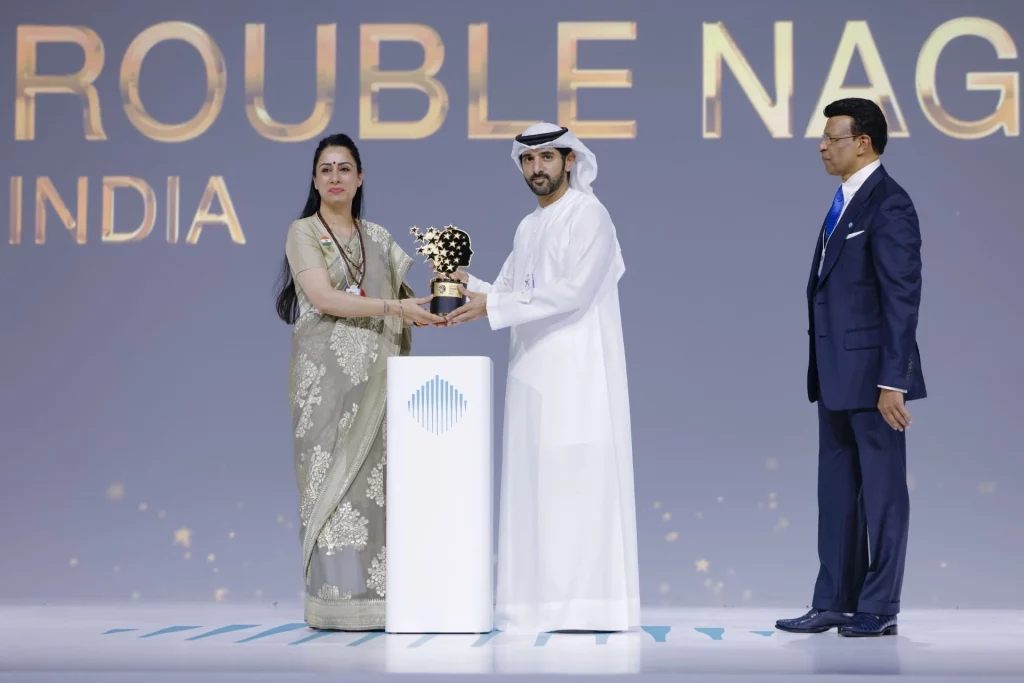
Navigating the intersection of social work, education, and the arts for the last 20 years, Rouble was recently honoured with the $1 million GEMS Global Teacher Prize 2026. She accepted the award at the World Governments Summit in Dubai, an annual event that draws leaders from across the globe.
The icing on the cake? The Crown Prince of Dubai, Sheikh Hamdan bin Mohammed bin Rashid Al Maktoum, handed over the prize — a proud moment for Rouble. “It was a very surreal moment, and a huge honour to receive the prize onstage from His Highness Sheikh Hamdan bin Mohammed bin Rashid Al Maktoum,” smiles Rouble, who was selected from over 5,000 applications and nominations across 139 countries.
Alongside the Crown Prince was Sunny Varkey, Founder of GEMS Education and the Varkey Foundation, which runs dozens of schools in Egypt, Qatar, and the UAE.
The selection process
The journey began with an extensive application detailing Rouble’s work and impact as a teacher. It was assessed by an independent panel, which shortlisted candidates to a Top 50, then a Top 10. The winner was selected from the Top 10 finalists by the Global Teacher Prize Academy, comprising prominent individuals from the worlds of education, art, sports, business, and beyond. Rouble is the 10th teacher to win the award, which the Varkey Foundation has presented annually since 2015.
Praise from UNESCO
Stefania Giannini, UNESCO Assistant Director-General for Education, said Rouble’s prize “reminds us of a simple truth: teachers matter.” In comments carried on the prize website, Giannini said UNESCO was “honoured to join the Global Teacher Prize in celebrating teachers like you who, through patience, determination, and belief in every learner, help children into school — an act that can change the course of a life.”
Investing in skills
Rouble intends to use the prize money to build a skilling centre that will offer free vocational and digital literacy training. “The aim is to expand opportunities for marginalised children and young people by providing practical skills, digital education, and pathways to employment and self-reliance.”
Global legacy of winners
Past winners of the Global Teacher Prize include a Kenyan teacher from a remote village who gave away most of his earnings to the poor, a Palestinian primary school teacher who teaches her students about non-violence, and a Canadian educator who worked in a remote Arctic village of Inuit students. Last year’s winner was Saudi educator Mansour Al-Mansour, known for his work with underserved communities in the Kingdom.
View this post on Instagram
The birth of Rouble Nagi Art Foundation
Rouble began teaching in 2011 through the Rouble Nagi Art Foundation (RNAF), which she founded to ensure that children from marginalised communities receive meaningful education and support. She started with 30 children in one small workshop and has now reached over a million.
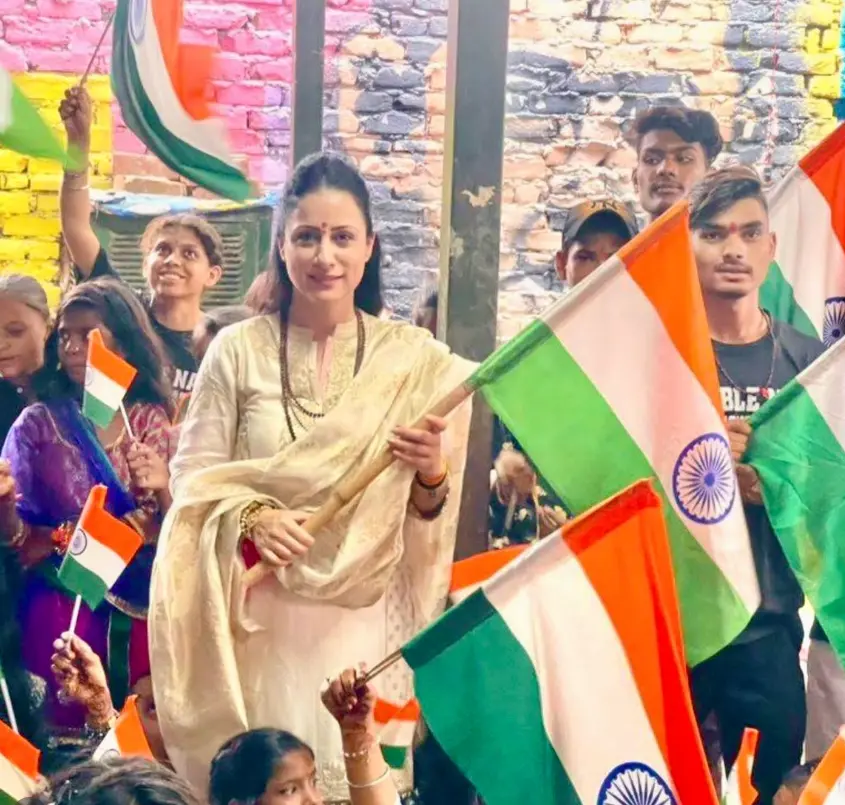
“Over the last two decades of social and art-based work, and more than a decade of teaching, my classroom has extended beyond four walls into narrow lanes, courtyards, and community spaces in slums and villages across India,” says Rouble, who believes, as Picasso did, that “Every child is an artist.” Prior to starting RNAF, she conducted art camps and taught art for the NGO Pratham from 2005 onwards.
Art meets academics
Rouble’s teaching approach integrates art with academic learning, using storytelling, role-play, recycled materials, and murals to make education interactive and meaningful. “Many children in slums are first-generation learners whose families cannot afford school fees or lack awareness of the importance of education,” she says. By providing accessible, culturally relevant learning opportunities, she seeks to disrupt cycles of poverty and create pathways back into formal schooling.
Roots in Jammu & Kashmir
Born in Devli village in Jammu & Kashmir, Rouble’s childhood — like that of many children of Army personnel was defined by movement, discipline, and exposure to India’s magnificent diversity. Her father served as an Army Officer and had the honour of commanding the Rajputana Rifles, a regiment of the Indian Army.
“His sense of duty, fearlessness, and service shaped my worldview from an early age,” says Rouble, who studied in various Army Schools, Kendriya Vidyalayas, and cantonment-based institutions across India — experiences that made her adaptable, curious, and open to learning from every environment.
Her mother, a homemaker, was her first teacher. “Everything I understand today about empathy and nurturing communities comes from observing her quiet strength.”
Growing up across India
Growing up, she lived in Jammu & Kashmir, Punjab, Assam, Karnataka, Rajasthan, Madhya Pradesh, Maharashtra, and West Bengal. “Each state added a new layer to my identity — new cultures, new languages, new art forms,” recalls Rouble, who was drawn to extracurricular activities and thrived outdoors and on the sports field, alongside academics. “Sports taught me discipline, teamwork, and the joy of pushing one’s limits.”
The Shantiniketan influence
Among all her experiences, her time in West Bengal left a profound mark. It was there that Rouble was first introduced to the depth and beauty of Indian art. “My frequent visits to Shantiniketan opened my eyes to how creativity can be a medium for expression, healing, and social transformation. This early exposure sowed the seeds for my journey as an artist.”
Discipline through NCC
She also earned her C Certificate in the National Cadet Corps (NCC), one of her most cherished achievements. “Looking back, my childhood was a beautiful blend of movement, discovery, discipline, and creativity. It taught me that every place has a story and every person has a lesson to offer.”
Living textbooks
Rouble teaches a class at one of her centres every day. In Mumbai’s slums, she conducts art classes twice a week at each location. The sessions are interactive, loud, cheerful, and full of movement. “Teaching in a slum is never a quiet, formal affair — it is vibrant, alive, and deeply rooted in the realities of the children who live there.” Her art curriculum is intentionally blended with what children learn in school, helping them understand stories visually, emotionally, and imaginatively.
“Many children in underserved communities struggle with comprehension when learning only from textbooks. But when they paint, touch, build, or perform, the story comes alive in their minds,” she says, pointing out that her walls are “living textbooks.”
Community-driven education
Rouble says education in marginalised communities is shaped by poverty, irregular attendance, lack of infrastructure, and social pressures such as child labour and early marriage. “To ensure access for children from low-income families, education must be flexible, low-cost, community-driven, and rooted in children’s lived realities.”
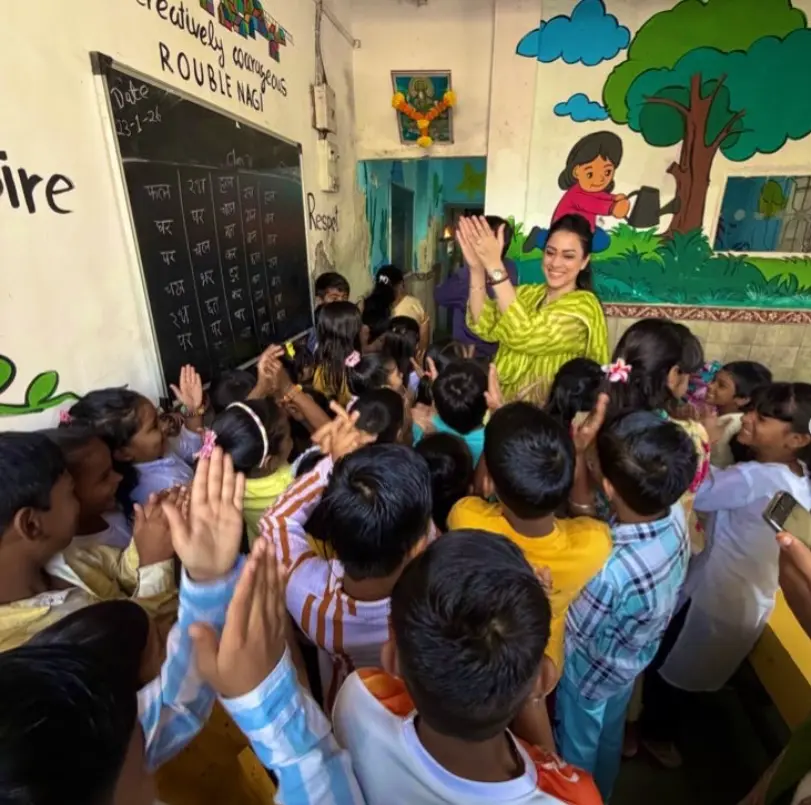
She believes learning must be interactive and creative, integrating art-based methods, recycled materials, and practical skills. “Building trust with families, providing flexible schedules for working children, and connecting education to immediate community needs are essential to improving enrolment, reducing dropouts, and sustaining long-term school retention.”
The muralist
As a muralist, Rouble has transformed public spaces with over 800 works worldwide. Her murals teach literacy, science, math, and history, among other subjects. She runs the Rouble Nagi Design Studio in Mumbai — a space that celebrates art, fuels creativity, enhances environments, and inspires communities.
“Art is not only an enriching part of life but also essential to physical, mental, and spiritual well-being. Therefore, the aesthetic beautification of spaces through artworks and installations is something I take seriously.”
‘The Slum Queen’
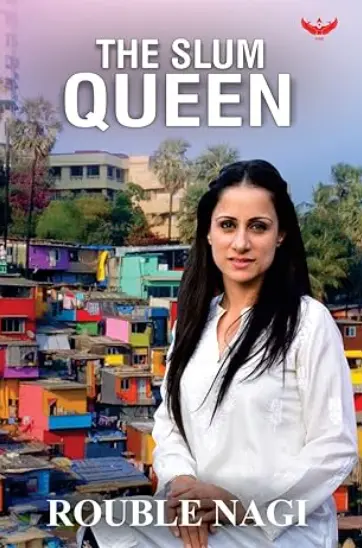
Rouble also authored a book, The Slum Queen — a title gifted by her students. “The book is an ode to all those who dream of change, of uplifting the less fortunate.” It chronicles her vision for India and documents the journey of her ‘Misaal India’ campaign, which began in a Mumbai slum and aims to build a brighter future. As part of the campaign, several workshops and skill centres have been launched across slums and villages in India.
Studio Saksham
Rouble is also the founder of Studio Saksham, an online village market dedicated to empowering women in slums and rural areas by bringing their craftsmanship to a global audience. Beyond her work, she enjoys exploring new cultures and spending time in nature — both of which inspire her creativity and community projects. “But it is my daily work with children that keeps that creative fire alive in me,” she signs off.
ALSO READ: Rajni Kumar: The remarkable tale of an educator with British roots and Indian heart