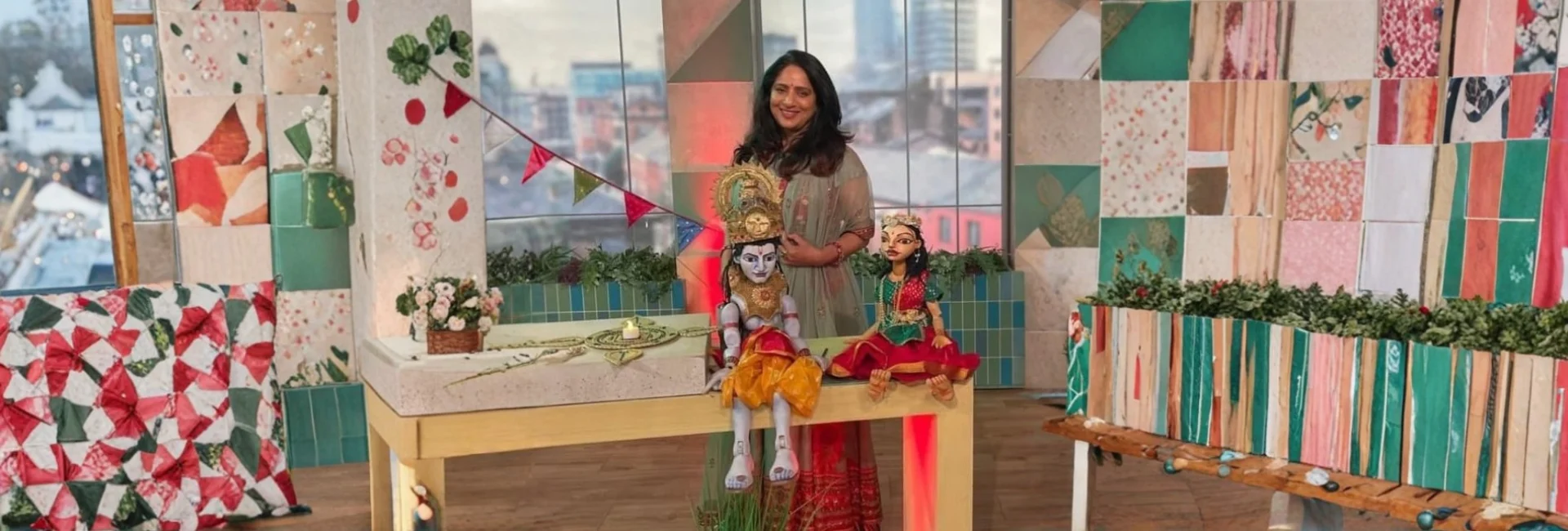


(February 24, 2026) For nearly a decade, Neelima Penumarthy has been quietly shaping how global audiences understand India, not through classrooms or textbooks, but through voice, memory, and performance. The Hyderabad-born storyteller and educator founded StoryHour in 2016 to present Indian epics and history in formats modern listeners could actually engage with: short audiobooks, narrated by teenagers, and intimate performances staged in community spaces.
Her very first production, Ramayana: An Ancient Indian Epic, released on Audible received international attention for its authenticity. Recorded and narrated by her teenage sons, it was praised in UK print media and later featured in the in-flight entertainment catalogues of British Airways and Qatar Airways. Listeners loved the clarity of language and the natural delivery of young voices discovering their heritage.
Her 2021 audiobook on India’s freedom movement, From the Mughals to the Mahatma, was reviewed as a “must listen” by Shashi Tharoor. What makes these projects remarkable is not just their reach, but their creators: teenagers across continents narrating civilisational history in their own words.
At 53, Penumarthy has become an understated cultural ambassador, someone helping diaspora children understand where they come from while helping non-Indians understand what India means.
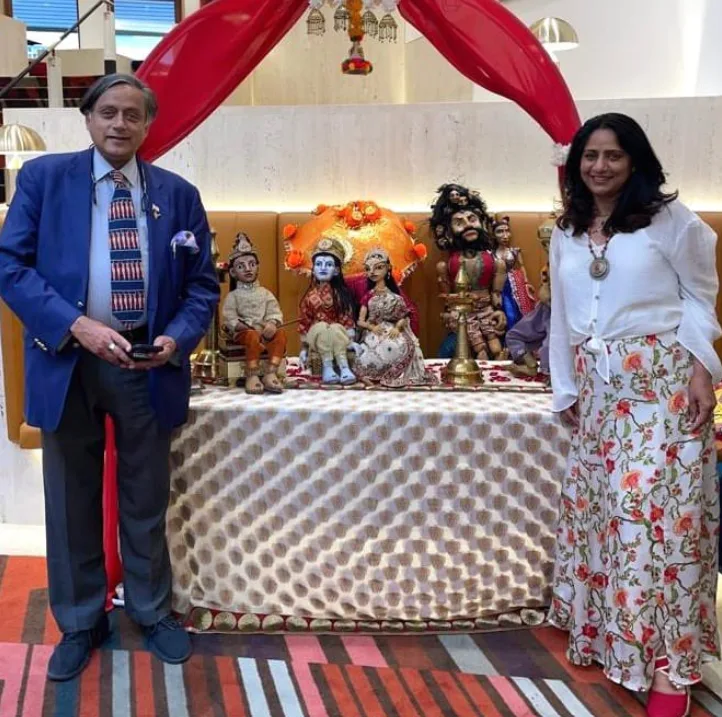
Neelima with Shashi Tharoor when he visited UK in 2023 for the London edition of JLF
A mind across disciplines
Neelima grew up in Hyderabad in a household where science and literature held equal importance. Her father, a chemical engineer working in the pharmaceutical industry, instilled in her a fascination for drug discovery and human biology. Her mother, an English teacher at Kendriya Vidyalaya, passed on a love for language, books, and expression.
Those influences shaped her personality early: analytical curiosity balanced by narrative sensitivity. In 1996, she moved to the United Kingdom on the prestigious Chevening Scholarship to pursue an MSc in Chemistry at Imperial College London. Around the same time, her husband Satish Pulle began working in finance in London.
Her career path initially followed technology. She transitioned into software development and worked as a Java developer while raising her first child. After the birth of her second son in 2004, she chose to stay home, It was a decision that unexpectedly opened the door to storytelling. Reading aloud became routine. Watching stories unfold through her children’s eyes became revelation. “I felt immense joy seeing their eyes light up while listening to stories,” she recalls in a chat with Global Indian.
The birth of StoryHour
Living abroad, Penumarthy noticed something important — many children knew Diwali celebrations but not the story behind them. Indian heritage existed as festival, food, and clothing, but not narrative understanding. Her solution was deceptively simple: let children tell the stories themselves. “My aim is to introduce complex topics in an easier way. It could be a book on Telugu proverbs or one where I explain Sanskrit shlokas in a simpler, contemporary language to the tweens and teens or today,” she says
In 2016, she asked her teenage sons to write and narrate their own version of the Ramayana. The result was refreshingly modern: concise, conversational, and accessible. Listeners responded instantly to the authenticity of teenage voices speaking naturally instead of formal narration.
The audiobook became the foundation of StoryHour. Soon she expanded the idea beyond mythology. She wanted her sons, growing up in Britain, to understand the shared history between India and the UK. That led to a new project: a one-hour narrative tracing events from the arrival of the East India Company to independence under Mahatma Gandhi.
Remarkably, the script was written during the pandemic by teenagers in two countries, her son Ayur in the UK and Aarush in India, collaborating over Zoom at just 15 years old.
The project showed Penumarthy something powerful: young people do not reject tradition; they engage when it speaks their language. “I truly believe this builds language confidence in pre-teens and teenagers — which is even more important in an AI-driven world,” she says.
For the Telugu version of the Ramayana audiobook, her mother, Smt Jahnavi, translated the text into Telugu and three students from Devnar Institute for Blind, Hyderabad narrated it beautifully. A retired teacher from DPS, Dr Sharada Manocha, brilliantly translated her Independence audiobook into Hindi, and it was narrated spectacularly by two students from The Blind Relief Association, New Delhi.
Storytelling as cultural bridge
StoryHour soon evolved beyond audiobooks into performance. Every year before Diwali, Penumarthy travels across London presenting a 15-minute Ramayana puppet show at schools, care homes, community centres, and cultural venues. The goal is simple: explain the festival in a way anyone can understand.
People from different backgrounds often approach her afterwards to say they finally understand the story behind the celebration they see around them each year. “If we understand each other’s stories, we are far more likely to respect one another,” she explains.
She has now produced seven audiobooks, including recordings in English, Hindi, and Telugu. One memorable experience came during multilingual Ramayana recordings, guiding narrators into voice acting was as enjoyable for participants as for her as director.
During the pandemic, she collaborated with friends and community members in London to narrate Telugu short stories written by their parents. The project connected generations separated by geography: elders providing stories, adults narrating them, and children listening
Living between Hyderabad and London
Despite decades abroad, she remains deeply connected to both worlds. “I’m Hyderabadi and Londoner in equal measure. Dil hai Hindustani,” she smiles.
She travels frequently between India and the UK and considers the movement enriching rather than conflicting. The dual identity shapes StoryHour itself, designed simultaneously for diaspora families and international audiences.
Her family shares a similar intellectual diversity. Her husband Satish Pulle remains her strongest supporter and sounding board. Her elder son Shreyas works at Google DeepMind, while her younger son Ayur studies physics at Imperial College London. The home remains filled with discussions: science, history, philosophy, and storytelling overlapping naturally.
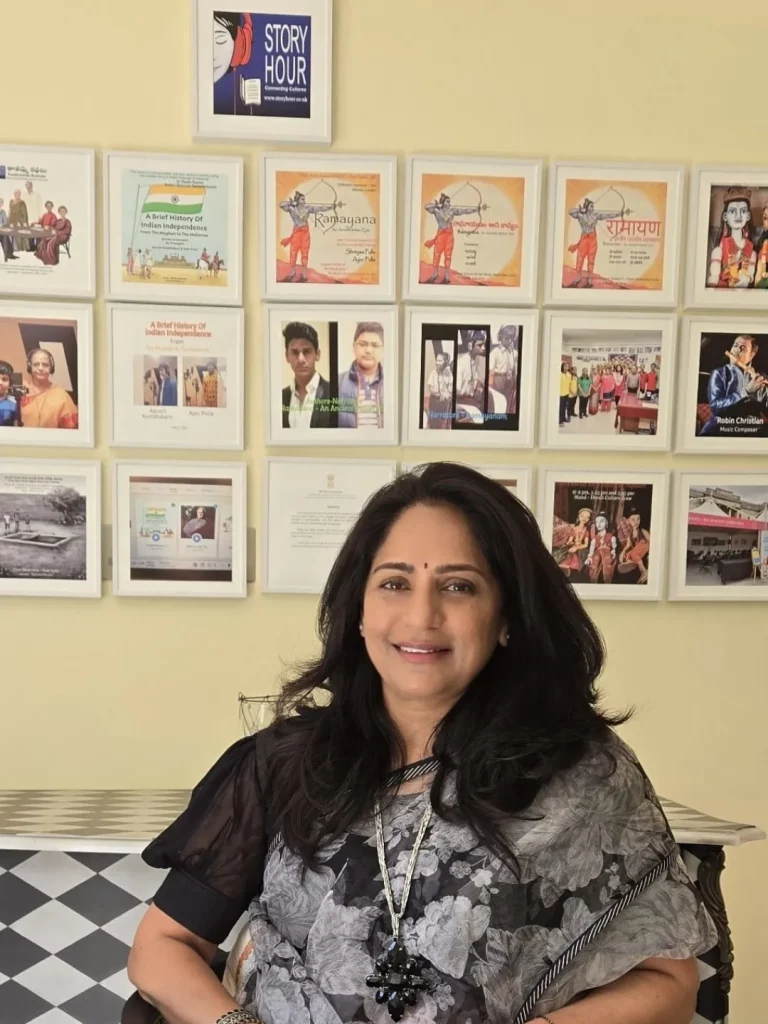
Neelima Penumarthy
Beyond narratives
One of Penumarthy’s biggest challenges is distribution. She handles nearly everything herself: founder, organiser, content creator, technical coordinator, and director. Yet the mission keeps expanding.
She believes storytelling plays a practical role in education: especially communication confidence among young people growing up in digital environments. Through narration, teenagers learn diction, expression, and articulation: skills often overlooked in formal schooling. Her work also connects generations. She enjoys working equally with energetic teenagers and reflective elders, describing herself as “a conduit between the two.”
The road ahead
Looking forward, Penumarthy hopes to collaborate more widely and bring additional stories to new audiences across languages and formats. She plans to continue developing workshops, performances, and audio productions that combine learning with enjoyment.
She also wants to expand community participation: encouraging people not just to listen, but to tell stories themselves. In a world increasingly shaped by algorithms and artificial intelligence, Neelima Penumarthy believes the human voice still holds unique power, the ability to carry memory, identity, and empathy as well as stories as old as time itself across continents.
ALSO READ: Anu Sehgal: Promoting South Asian cultural literacy in the US