


(January 5, 2026) Few individuals have shaped India’s crafts ecosystem as profoundly and as fearlessly as Jaya Jaitly. A textile expert, writer, social activist, and former politician, the textile czarina has spent over four decades championing the dignity, relevance, and economic power of India’s artisanal traditions. From reviving endangered crafts to redefining how handloom and handicrafts are viewed in global marketplaces, her work has left an indelible imprint on India’s cultural and creative landscape.
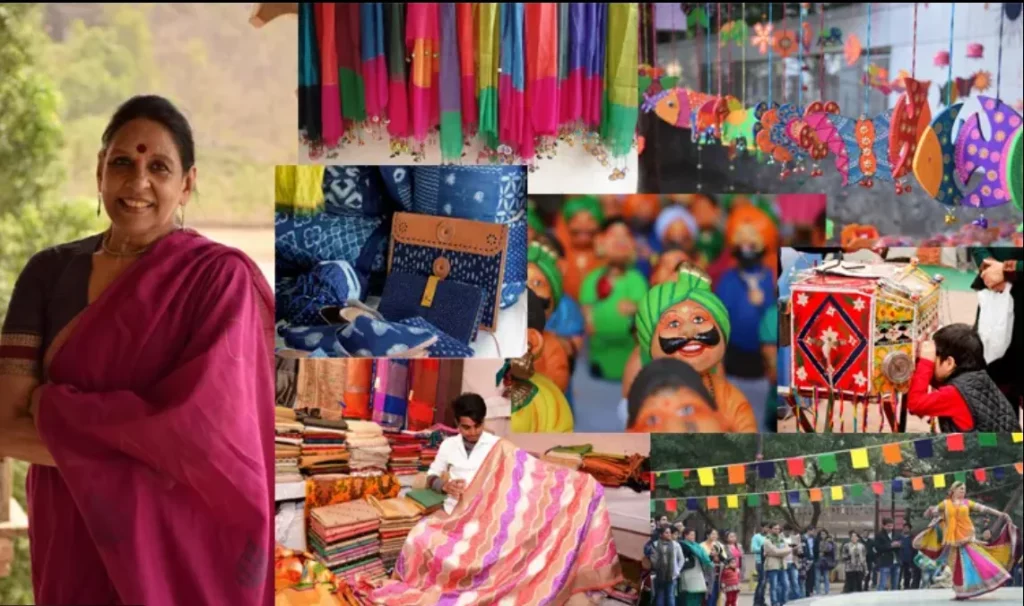
Founder of the Dastkari Haat Samiti in 1986, Jaitly helped transform the way craftspeople engaged with markets, eliminating exploitative middlemen and restoring confidence to makers through direct interaction with buyers. Her role in conceptualising Dilli Haat (now replicated across India) created a pioneering model that merged livelihood, culture, and tourism.
View this post on Instagram
Over the years, she has worked closely with a vast spectrum of textile traditions across the length and breadth of the country, from Telia Rumal and Ikat to Patola, Kalamkari, pottery, metalwork, and countless lesser-known crafts scattered across villages, lanes, and homesteads rather than neatly defined “clusters.” Working with legends like Kamaladevi Chattopadhyay and Pupul Jayakar who helped revive Indian crafts after Independence, she has devoted her life to ensure that the rich legacy of India’s textiles found their place under the sun.
A prolific author, Jaitly has documented India’s textile and craft traditions with scholarly rigour and deep empathy. Her books include Crafts of Jammu, Kashmir and Ladakh, The Craft Traditions of India, Vishwakarma’s Children, Akshara: Crafting Indian Scripts, and her recently released political memoir Life Among the Scorpions. Through her writing, she has preserved knowledge systems often excluded from formal histories, giving voice to craftspeople’s lives, labour, and creativity. Her contributions have earned her wide recognition, including national and international honours for cultural advocacy and social impact.
Aesthetics with a purpose
The revivalist traces her commitment to crafts to a deeply personal foundation. “I was strongly influenced by my father’s fine aesthetic sense and love for reading and writing, and by my mother’s compassion for those in need,” she reminisces in a chat with Global Indian. “As I grew up, this combination worked perfectly for me to work with people of great artistic skill who were in dire need of advancement.”
That convergence of aesthetics and social responsibility found its natural home in India’s crafts world. Early encounters proved formative. A visit to Kashmir in 1965 introduced her to master artisans struggling to survive despite extraordinary skill. “I started sending their work to Delhi, to friends’ stores and Cottage Emporiums,” she recalls. When cultural doyenne Pupul Jayakar invited her to consult for the Kashmir Cottage Emporium, Jaitly found her life’s direction.
Though she never formally studied design, instinct and immersion became her teachers. “I realised the best way to eliminate middlemen was to make them salesmen,” she says. A philosophy that would later underpin Dilli Haat and Dastkari’s entire approach.
From collective voice to a movement
Founded with just 90 members, Dastkari Haat Samiti emerged from the 83-year-old’s growing engagement with trade unions and non-electoral political activism. “There was a need for a common platform where concerns could turn into larger projects for self-reliance and egalitarian principles,” she explains. Dastkari was envisioned not merely as an organisation, but as a collective voice for craftspeople across caste, belief, and gender.
Over nearly four decades, she has resisted rigid bureaucratic frameworks such as the “cluster” model. “Crafts activity is not always located in one bunch,” she says. “It might be in a lane, a homestead, a studio, scattered across landscapes. I rely on personal discovery, instinct, and building friendships.”
Among her most meaningful interventions was the six-month reinvigoration of pottery in a Kerala village once trapped in cycles of prostitution due to historical exploitation. Funded by the Development Commissioner (Handicrafts), the project restored both livelihood and dignity, long before such work was framed in contemporary development jargon.
Jaitly has witnessed the crafts sector undergo dramatic shifts: from post-globalisation threats to a resurgence fuelled by design innovation, policy support, and renewed public interest. “It is gratifying to see crafts moving from heritage into contemporariness,” she observes. The proliferation of haats, bazaars, and luxury craft spaces (including Delhi’s Kunj, established by the Ministry of Textiles) signals changing perceptions.
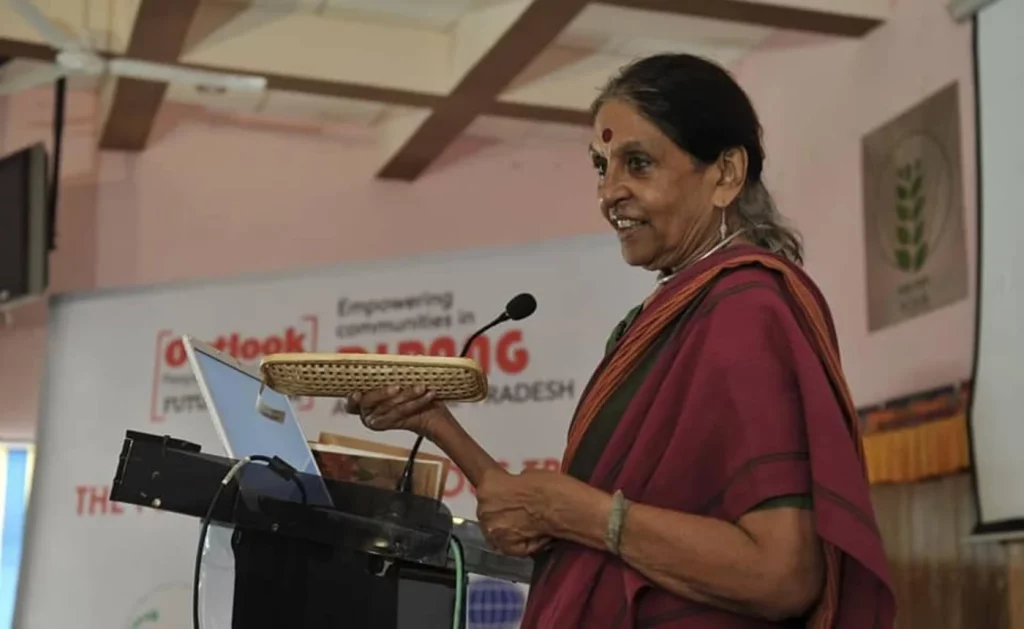
Yet she remains clear-eyed about what gives crafts their strength. “Their beauty lies in uniqueness, not standardisation,” she says. “The excellence of a creative mind, wise heart, and skilled hands — and the human interaction between maker and buyer — that is something no machine can replicate.”
Craft, economy, and India’s soft power
For the legend, heritage and economy are not opposing forces. “Why can the two not combine?” she asks. “Heritage skills evolving with time are how societies move forward economically. Heritage does not drag economies down — it enhances them.”
On the global stage, Indian crafts play a vital role in shaping soft power. From international fashion runways to home décor and tourism, handcrafted traditions carry India’s story abroad. The textile savant herself has led workshops and exchanges with artisans from Iran, Egypt, Israel, Pakistan, Southeast Asia, Sri Lanka, and 18 African countries. “The learning, sharing, and friendships that developed were extraordinary,” she says. “Craft builds understanding where politics often fails.”
Writing has been central to her advocacy. “I write to share the knowledge I’ve gained and for catharsis when I feel strongly,” she explains. Her books often function as extensions of her work: blending documentation, storytelling, and action.
Vishwakarma’s Children, for instance, reads like lived case studies of craftspeople’s daily realities, while Akshara merges calligraphy with craft practice.
Asked which milestone she is most proud of, Jaitly does not hesitate. “Dilli Haat,” she says. “It was the toughest and most satisfying project of my life.” Conceived as an uplifted version of a traditional Indian roadside market, it enabled craftspeople to gain confidence, self-reliance, and community while reaching a wider audience. She remains vocal about how its original ideals have since diluted: proof that her advocacy does not end with success.
View this post on Instagram
Looking ahead
Through years of political life and public scrutiny, what kept her anchored was simple. “Pure love and pleasure in creating beauty, happiness, and a better life for our creative people,” she says. Politics, she adds, taught her fearlessness: but crafts are where her heart remains.
As India modernises rapidly, she believes crafts will survive where respect and revenue go hand in hand. “Whenever craftspeople are given both, younger generations continue with pride,” she notes.
Her advice to young designers and cultural custodians is characteristically forthright. “Be serious. Learn deeply. And don’t run to Google, ChatGPT, or AI at the very beginning,” she warns. “They will blank out your own thoughts. Contribute your own knowledge. Don’t be lazy.”
Looking back on a life dedicated to creativity, Jaitly reflects, “Creativity brings true freedom. It keeps you alert, thoughtful, energised.” Plans, she says with a smile, are endless: but the work continues.
In Jaya Jaitly, India finds its cultural conscience, one that insists tradition must live, evolve and empower.
ALSO READ: Bunker Roy: Upskilling communities and spreading practical wisdom for global development